

You can start poultry farming in Kenya with just Ksh30,000. Here is the process:
I am sharing this advice to help those who are stuck in starting a poultry business.This will help someone who has KSh 30,000 but has no idea what to do with it.
I am assuming you already have a simple poultry structure constructed or a room you are not using.I am also assuming you already have drinkers and feeders in place.
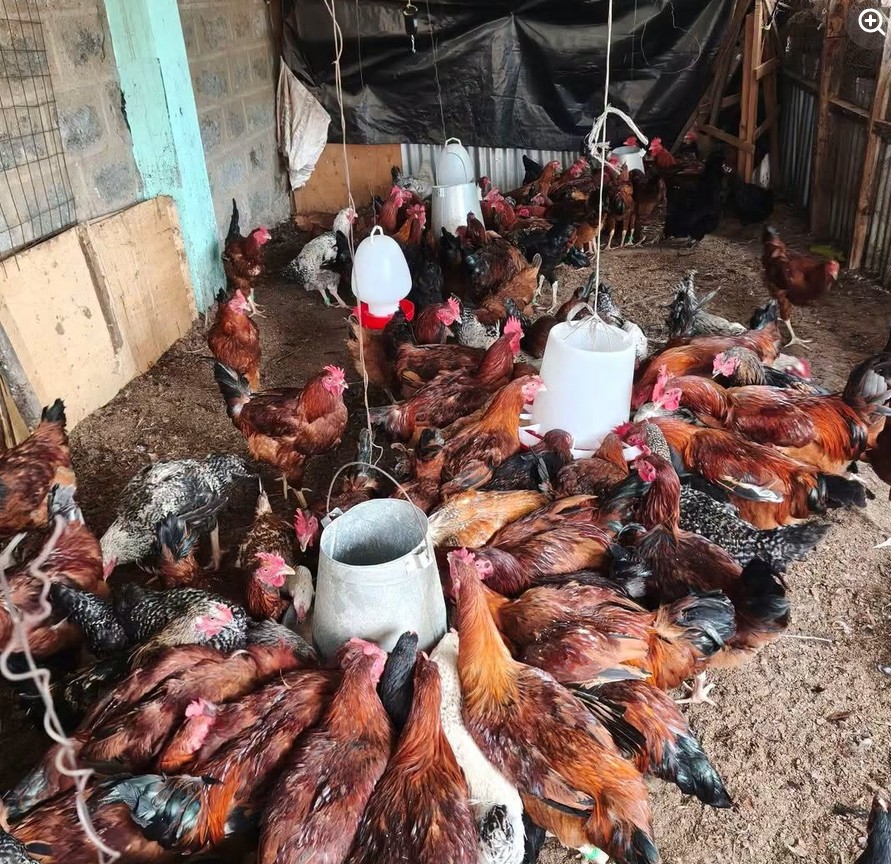
STEP 1: START WITH GOOD BREEDING STOCK.
Go to the village and find someone with a good track record of raising healthy indigenous/kienyeji chickens.
Buy 10 pure kienyeji hens that are already laying or are about to start laying, plus 2 cocks.
Let’s assume each hen costs KSh 800 and each cock costs KSh 1,200.
Next, find a farmer who raises F1 improved kienyeji chickens, such as Kenbro, rainbow rooster, premium kienyeji or Sasso, and buys chicks from a reputable company. Purchase 10 improved kienyeji hens at 800 ksh each that are laying or are about to start laying, plus 2 cocks at 1200 kshs(The prices depend on location of the farm you are sourcing from.Could be higher or lower).
By now, you will have spent about 20,800 kshs
You have 9,200 kshs as the remaining balance.You now have 20 hens and four cocks. Keep the pure indigenous chickens separate from the improved ones.
STEP 2: INVEST IN QUALITY FEED.
Use the remaining 9,200 kshs. to buy two 70 kg bags of good-quality layers mash: one for the pure indigenous hens and one for the improved hens at 4000 kshs each.That will total to 8000 kshs. You are now left with 1,200 kshs.Buy Newcastle with IB vaccine 100 doses at 300 ksh plus 100 mls multivitamin at 250 kshs. You have a balance of 650 kshs
Your poultry journey starts from here.We assume you already have a simple poultry structure.
Pure indigenous and improved kienyeji chicken will generally consume about 100 grams to 110 grams of feed per bird daily.That’s about 2.4 kgs to 2.6 kgs.Supplement their diet with greens and left over fruit wastes.
STEP 3: LET THE EGGS START PAYING YOUR BILLS
Let’s assume your 10 pure indigenous hens give you 5 to 7 eggs daily, while the ten improved hens give you 6 to 8 eggs daily.
That gives you approximately 11–15 eggs per day.
In two days, you could have close to a tray of eggs. If you sell a tray of fertilised eggs for kshs 600, 3 trays per week could bring in KSh 1,800.
That is approximately KSh 7,200 in gross sales over four weeks, assuming you consistently sell three trays every week.
Remember, this is an estimate, not a guarantee. Actual production depends on the age, health, nutrition and fertility of your birds, and you must deduct your running costs.
The goal is to let the business gradually contribute towards its own feed and other expenses.
STEP 4: MULTIPLY YOUR FLOCK INSTEAD OF BUYING EVERYTHING.
When your pure indigenous hens become broody, use the opportunity to multiply your flock.
If 5 hens each hatch 10 eggs successfully, you could get up to 40 to 45 chicks. With 6 hens, that could be 48 to 54 chicks.
The number of chicks you actually get will depend on fertility, hatchability and the number of eggs each hen can cover properly.
After hatching, provide the chicks with adequate warmth, appropriate starter feed, clean water and a proper vaccination programme. Keep them safe and manage them according to their age.
Once the pure indigenous hens have produced another batch, you can use suitable fertilised eggs from your improved hens to produce improved kienyeji chicks.This is how you gradually build a bigger flock without depending entirely on buying new birds.
STEP 5: INVEST IN A SMALL INCUBATOR.
As the business grows and you have saved enough money, consider buying an incubator.
A small incubator with a capacity of around 128 eggs may cost about 15,000 kshs to 20,000 kshs. depending on the model and supplier.
Collect suitable fertilised eggs every week, incubate them, and sell day-old chicks or raise some yourself.
You can sell pure indigenous chicks and improved indigenous crossbred chicks to farmers who want to start their own poultry projects.
Build your reputation by providing healthy, properly managed chicks and being honest with customers about their breed and vaccination status.
Vaccinate chicks against diseases such as Newcastle,Gumboro and fowl pox according to an appropriate vaccination programme and the vaccine manufacturer’s instructions.
When customers receive quality chicks and good advice, they are more likely to return and recommend you to other farmers.
STEP 6: CREATE MULTIPLE SOURCES OF INCOME.
As your flock grows, you can sell some birds at around three months of age for meat, depending on their breed, weight and the market price.
Keep your best breeding birds to produce more fertilised eggs. You can also build relationships with hatcheries and other poultry farmers who need a reliable supply of fertilised eggs.
Over time, your business can generate income from:
– Selling table eggs.
– Selling fertilised eggs.
– Selling day-old chicks.
– Selling growers and mature birds.
– Supplying breeding stock.
– Providing poultry management advice as your experience grows.
Do not rush to sell every bird. Keep enough good-quality breeders to maintain and expand your flock.
MY FINAL ADVICE TO YOU.
You do not need millions of shillings to begin building a poultry business. You need a clear plan, good breeding stock, proper management, patience and the discipline to reinvest part of your earnings.
Start small, learn as you go, keep records and grow step by step.Your first KSh 30,000 may not make you rich overnight, but with the right management, it can be the foundation of something much bigger.
Together let’s fight poverty.